Islam Makhachev walked into Xfinity Mobile Arena in Philadelphia as the most dominant active fighter in the sport. He walked out as the holder of the longest winning streak in UFC history, having surpassed Anderson Silva’s record of 16 consecutive victories with win number 17 over Ian Machado Garry.
By every objective measure, the night belonged to him. And yet, something felt different about the way it ended.
This was not the Islam Makhachev who suffocated Charles Oliveira, dismantled Alexander Volkanovski twice, or systematically broke down Jack Della Maddalena. This was a Makhachev who had to work considerably harder than expected, absorbed visible damage to his face, and was forced to rely almost entirely on his wrestling and top control to see out a unanimous decision against a fighter many considered a significant step down in competition.
The Record Is Historic. The Performance Was Complicated.
Surpassing Anderson Silva’s consecutive UFC victory record is not a small achievement. Silva built that streak across a generation of dominant middleweight title defences that redefined what championship-level MMA looked like. Islam Makhachev has now gone further, spanning multiple weight classes and finishing opponents of the calibre of Oliveira, Volkanovski, and Poirier along the way.
But UFC 330 complicated the narrative in a way that no previous Islam Makhachev victory has. Garry’s takedown defence held up better than almost any previous opponent, his orthodox stance and reach created genuine problems for Makhachev in the early exchanges, and the damage accumulated on Makhachev’s face over the course of the fight was more visible than anything we have seen in recent memory.
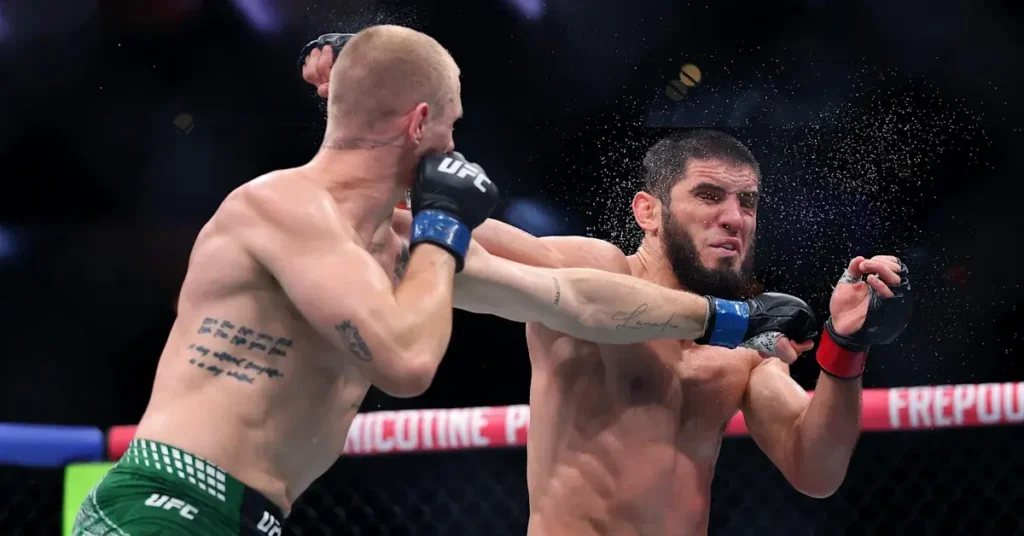
Islam Makhachev won the fight clearly and deserved the decision. What matters is what the performance revealed about where vulnerabilities might exist.
Garry, for his part, had moments where the champion looked genuinely uncomfortable. What he failed to do was press those advantages with the urgency they demanded. He had openings he did not walk through, exchanges he did not extend, and moments where the finish was there for a fighter willing to commit entirely to taking it. Dana White and Makhachev himself both noted the passivity post-fight. Garry’s lack of killer instinct may have saved Makhachev from a significantly more difficult evening than the scorecards suggest.
Did UFC 330 Provide a Blueprint for How to Beat Islam Makhachev?
That is the question the welterweight division is now asking. For the first time in a long time, an opponent demonstrated enough success against Islam Makhachev in specific areas to make future contenders believe the fight is genuinely winnable. Early opening markets for potential Makhachev matchups against Carlos Prates and Michael Morales reportedly have him as a considerably narrower favourite than you would expect from a fighter riding 17 straight UFC victories. That market movement is not proof of anything, but it is a signal worth paying attention to.
Makhachev remains the welterweight champion and arguably the best fighter on the planet. What UFC 330 did was remove some of the aura of inevitability that had surrounded his performances. That is not the same as suggesting he is suddenly beatable. It is acknowledging that the gap between him and the elite of this division may be smaller than his record implies.
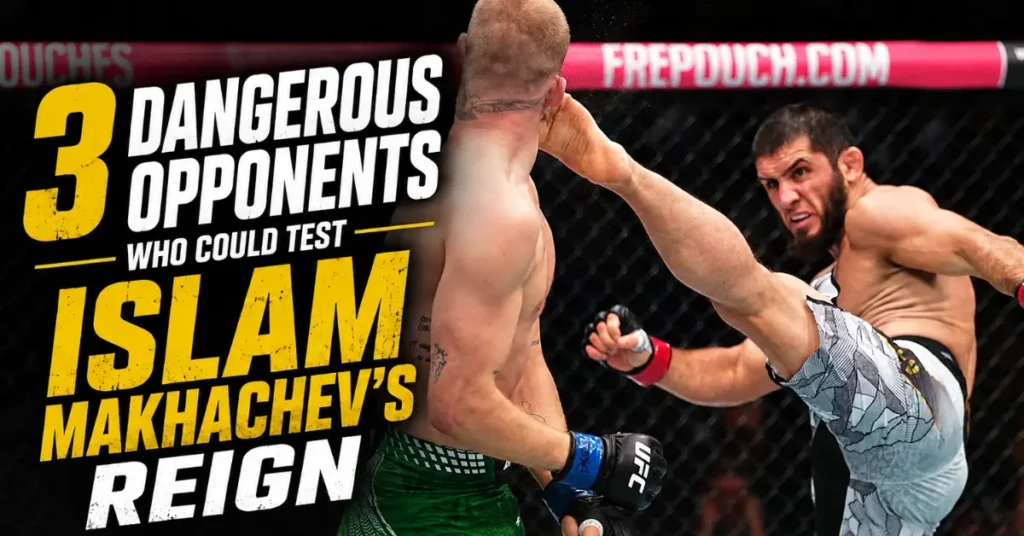
3 Dangerous Opponents Who Could Test Islam Makhachev’s Reign
Fight No. 1: Carlos Prates
Carlos Prates is the most logical immediate next opponent, and reportedly one Islam Makhachev himself has identified as deserving of a title shot following UFC 330. The Brazilian’s striking profile makes this a fascinating and genuinely dangerous stylistic challenge for the champion, arguably more dangerous than Garry in specific areas.
Where Garry’s size and reach created problems from the outside, Prates creates problems through explosive power and the kind of finishing instinct that Garry demonstrably lacked on Saturday night. Prates has the knockout power to punish takedown entries and the footwork to create prolonged striking exchanges that Makhachev, based on his UFC 330 performance, may not want to sustain over five championship rounds.
The key question is whether Prates can implement the blueprint Garry established without Garry’s size advantage. If the answer is that his finishing ability compensates for what he gives up physically, this becomes a more competitive fight than the title matchup narrative suggests.
The opening market odds indicating a narrower favourite margin than expected reflect exactly that uncertainty.
Fight No. 2: Michael Morales
Michael Morales represents the longer-term threat in the welterweight division. His recent stretch of knockout victories over increasingly credible opposition has built genuine momentum and positioned him as one of the most dangerous fighters in the top ten. His size, athleticism, and developing overall game give him tools that grow more threatening with every camp.
The argument against Morales as the immediate next fight is straightforward. Prates has a more established case as the next contender, and the UFC will likely reward that queue. But Morales as fight number two after Prates makes considerable sense, and if Prates represents the striking danger test, Morales represents the complete package test. A fighter with his physical attributes and finishing rate who continues developing his wrestling and defensive grappling becomes an existential threat to anyone in the division, including the champion.
Fight No. 3: Ilia Topuria
The superfight option requires one condition to be met first. Topuria needs to bounce back from his fourth-round corner stoppage loss to Justin Gaethje at UFC Freedom 250 and return to competition before the end of the year with a performance that re-establishes his elite status. His six-month medical suspension means that timeline is tight but achievable.
If that happens, Islam Makhachev versus Topuria becomes the most commercially compelling fight of the three by a significant margin. Before the Gaethje loss, Topuria was the number two pound-for-pound fighter in the world, undefeated, and a two-division champion. His knockout power, southpaw stance, and crossover appeal make the matchup enormous in terms of interest and fan investment regardless of the competitive calculus.
Topuria versus Makhachev is not the most logical contender fight. It is the fight with the biggest commercial upside and the most star power. If Topuria returns strong and Makhachev wants to make the biggest fight available to him, this is the one.
Islam Makhachev: The Man to Beat, But No Longer Untouchable
Islam Makhachev is still the best fighter in the world at welterweight. He holds the record for the longest UFC winning streak in history. He wins fights that are difficult in ways that lesser champions would not. That has not changed.
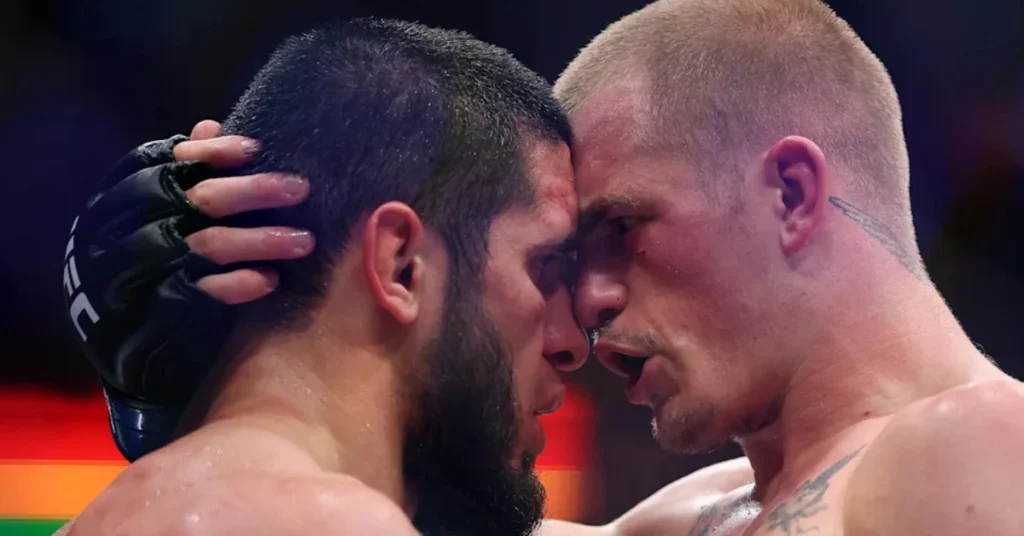
What UFC 330 changed is the perception of invincibility that had been building around him. Ian Machado Garry showed enough to make Carlos Prates, Michael Morales, and Ilia Topuria genuinely believe they have a path. Garry’s failure to convert his moments does not erase the fact that the moments existed.
The welterweight division now has a blueprint. Whether anyone can execute it more completely than Garry is the only question that matters heading into Makhachev’s next title defence.
About The Author